
Why GeoVisionCraft exists
Trade between China and Europe is being redrawn. A southern land route through Central Asia, the Caspian Sea and the South Caucasus, the Middle Corridor, is turning the region between them into a market of its own. GeoVisionCraft exists to make that change readable for companies in the Nordics and in the region, and to connect the two.
Economies we trackAbout usThe Belt and Road Initiative
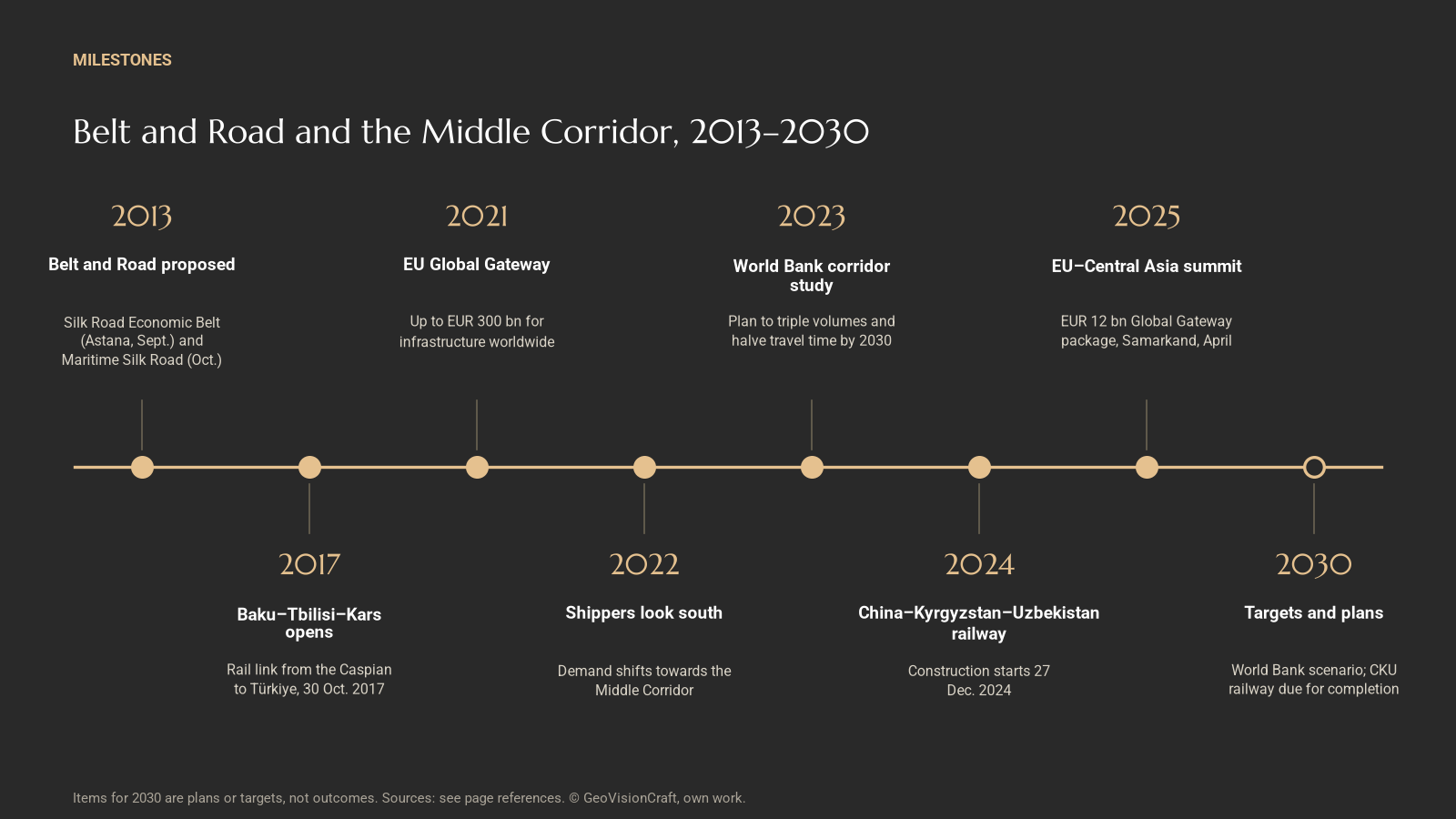
The Belt and Road Initiative (BRI) began as two proposals by China’s President Xi Jinping in 2013. In September 2013, in a speech at Nazarbayev University in Astana, he proposed a “Silk Road Economic Belt” with Central Asia. In October 2013 he added a “21st-Century Maritime Silk Road” (Ministry of Foreign Affairs of China). Together they became the “Belt and Road”.
The BRI is not a single fund or treaty. It is a framework of bilateral memoranda of understanding, state-backed lending, construction contracts and direct investment. According to China’s own white paper, by June 2023 China had signed more than 200 BRI cooperation agreements with more than 150 countries and 30 international organisations (State Council Information Office white paper, October 2023, via gov.cn).
China is not the only investor along the route. In December 2021 the EU launched Global Gateway, a strategy to mobilise up to EUR 300 billion in infrastructure investment worldwide (European Commission). At the first EU–Central Asia summit in Samarkand in April 2025, the EU announced a EUR 12 billion Global Gateway package for Central Asia (Council of the EU). For the economies along the route, that competition is an opportunity.
The Middle Corridor
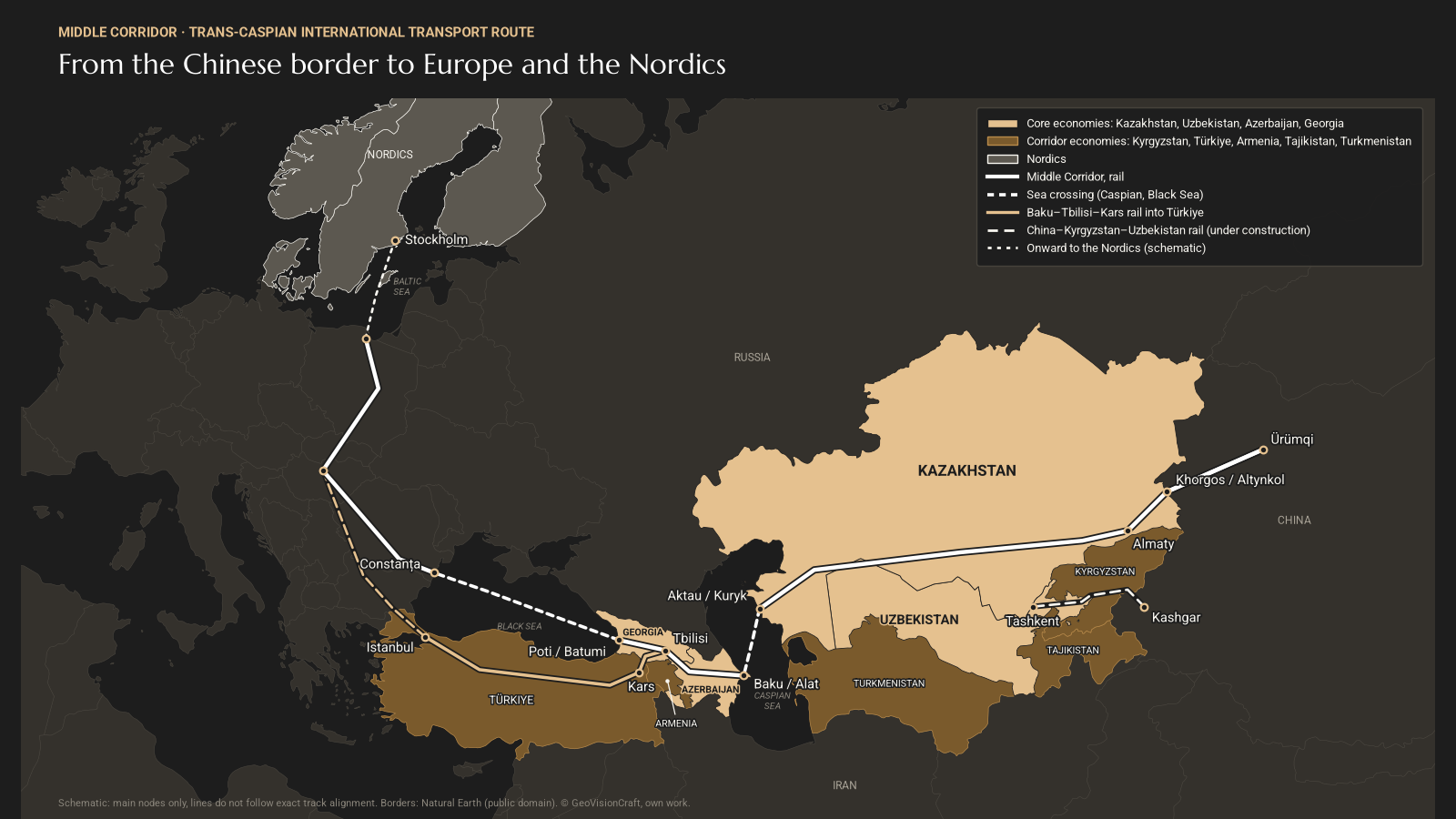
The Middle Corridor, also called the Trans-Caspian International Transport Route, runs from the Chinese border at Khorgos and Dostyk across Kazakhstan to the Caspian ports of Aktau and Kuryk. Ships cross to Baku and Alat in Azerbaijan. Rail then continues through Georgia, either to the Black Sea ports of Poti and Batumi or along the Baku–Tbilisi–Kars railway into Türkiye and on to Europe (World Bank, 2023, p. 5). The Baku–Tbilisi–Kars line opened on 30 October 2017 (Office of the President of Azerbaijan).
A second rail link from China is under construction. Work on the China–Kyrgyzstan–Uzbekistan railway officially began on 27 December 2024. According to the government of Uzbekistan, the line is 532.53 km long, is planned to carry up to 15 million tonnes of freight a year and is expected to be completed by the end of 2030 (Government of Uzbekistan).
≈ 4,500 km
Rail distance from Altynkol on the Chinese border to the Black Sea; about 6,200 km to Istanbul.
World Bank, 2023, p. 47
50–53 days
Average time in 2022 from Dostyk or Khorgos to Constanța in Romania, with the longest delays at the sea crossings.
World Bank, 2023, p. 8
×3 by 2030
With investment and reforms, freight volumes could triple compared with 2021 while transport times are halved.
World Bank, 2023, p. 11
15 Mt a year
Planned capacity of the China–Kyrgyzstan–Uzbekistan railway, due for completion by the end of 2030.
Government of Uzbekistan
Three ways between China and Europe
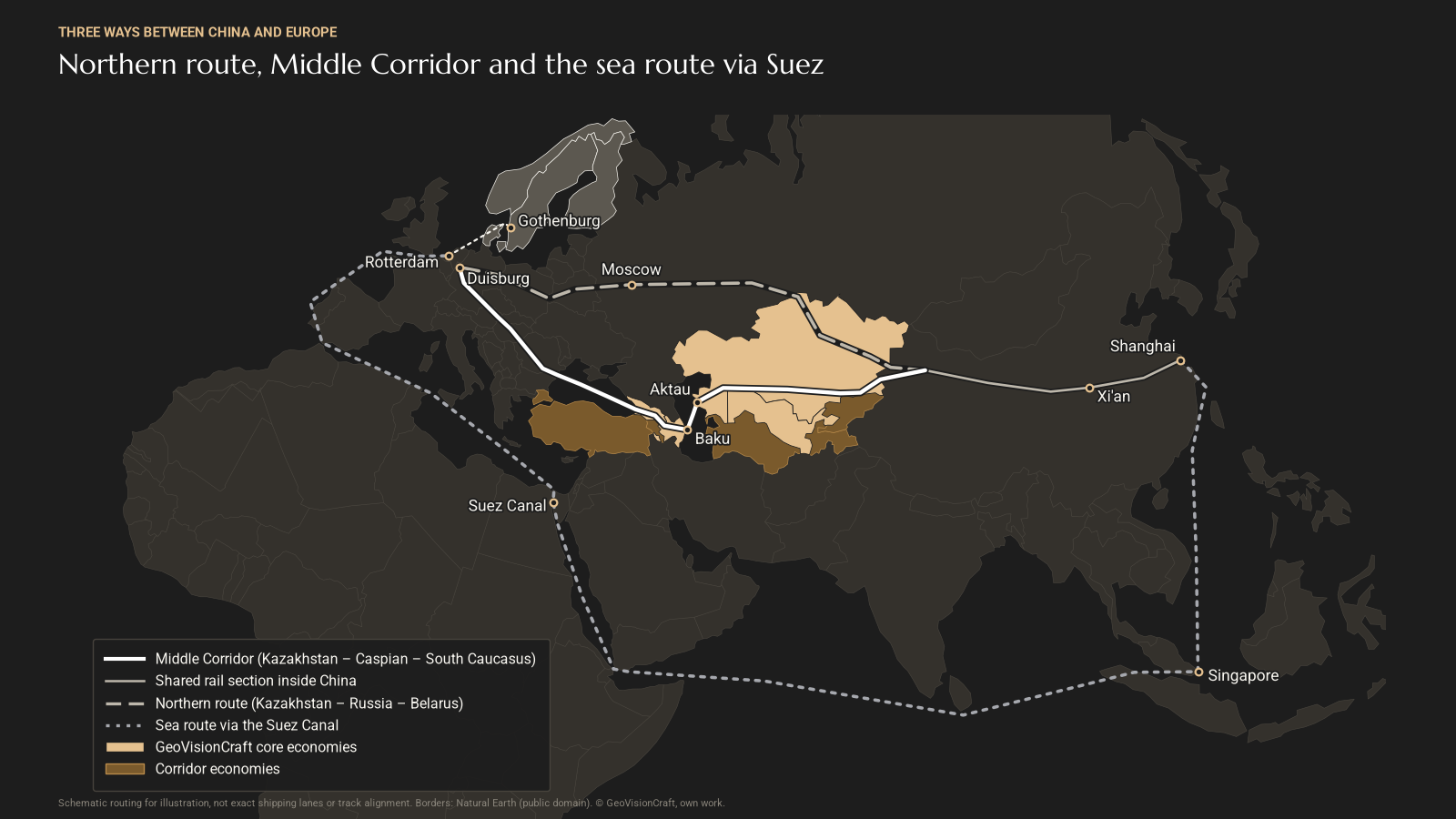
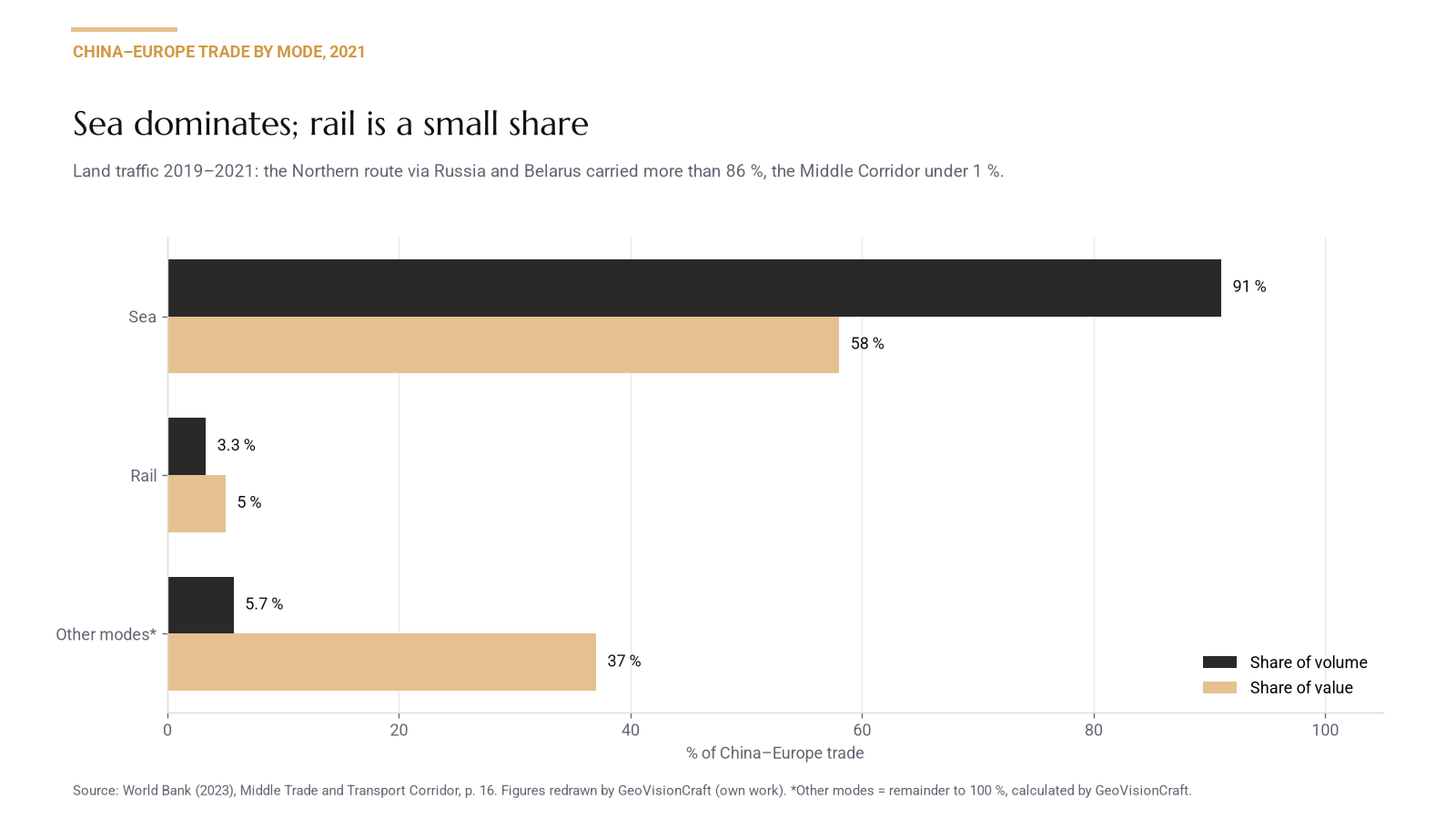
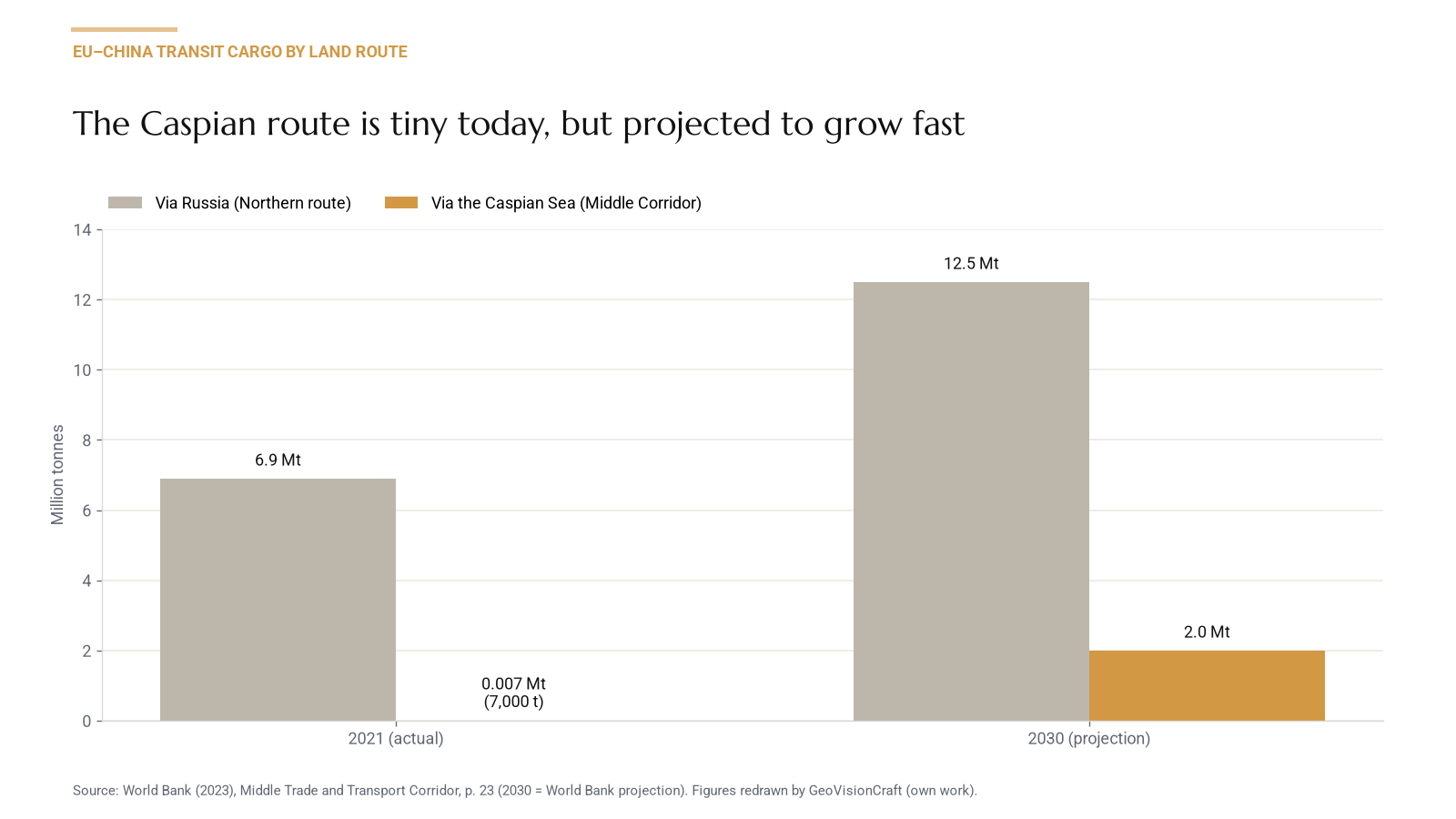
Goods between China and Europe move along three broad lines: by sea through the Suez Canal, by rail through Kazakhstan, Russia and Belarus, and along the Middle Corridor. The sea route carries most of the trade, and before 2022 the Northern route carried most of the land traffic. Since Russia’s invasion of Ukraine in 2022, the Middle Corridor has received far more attention as an alternative (World Bank, 2023).
| Route | Path | Role today | Time (2022) | Main constraint |
|---|---|---|---|---|
| Sea via Suez | Chinese ports – Strait of Malacca – Suez Canal – Northern Europe | About 91 % of China–Europe trade by volume and 58 % by value (2021) | Comparable to the Middle Corridor | Long distance and dependence on a few maritime chokepoints |
| Northern route | China – Kazakhstan – Russia – Belarus – EU | More than 86 % of China–Europe land traffic (2019–2021) | About half the Middle Corridor time | Transit through Russia, with sanctions and compliance exposure since 2022 |
| Middle Corridor | China – Kazakhstan – Caspian Sea – Azerbaijan – Georgia – Black Sea or Türkiye – EU | Under 1 % of China–Europe land traffic (2019–2021), but growing | 50–53 days to Constanța; 40–45 days via Türkiye | Sea crossings, vessel shortage, border procedures and rolling stock |
Source: World Bank (2023), Middle Trade and Transport Corridor, pp. 5, 8, 16, 39, 47. Times refer to 2022 and are averages.
Why the region matters for the Nordics
The Middle Corridor is more than a shortcut between China and Europe. The World Bank expects it to remain mostly a regional route: intercontinental trade would be under 40 percent of its volumes, and its main value lies in trade route diversification and connectivity for Kazakhstan, Azerbaijan and Georgia (World Bank, 2023, pp. 6–7). That is why we look at the region as a market in its own right, not only as a transit line.
Resilient supply chains
A working land route through Central Asia and the South Caucasus gives Nordic buyers another option besides the sea route and the route through Russia. The World Bank sees the corridor as a source of resilience for Europe–Asia trade in a volatile geopolitical context.
Growing markets
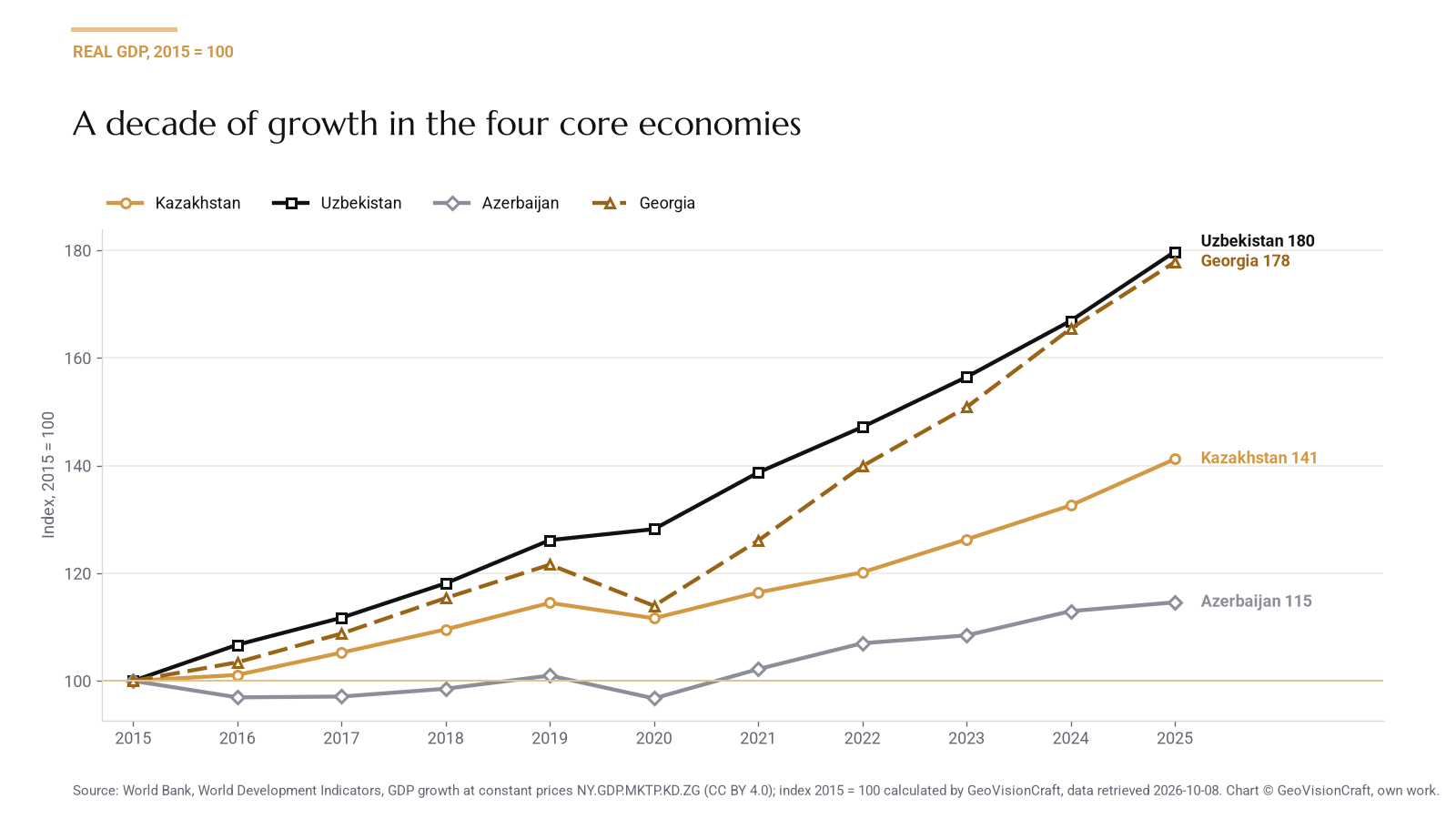
Between 2015 and 2025 the real economies of Uzbekistan and Georgia grew by about 80 percent, and Kazakhstan’s by about 40 percent (World Bank data, Figure 6). Growth on that scale creates customers, suppliers and partners.
Europe is investing
The EU’s Global Gateway package for Central Asia and Georgia’s Association Agreement with a free-trade area (DCFTA) tie the region closer to the European market that Nordic companies already work in.
The region is still hard to read from the Nordics. Data are spread across national central banks and statistics offices, often in several languages, and news rarely separates the trend from the noise. GeoVisionCraft was set up to close that gap.
Four core economies, five corridor economies
We follow four core economies along the corridor: Kazakhstan, Uzbekistan, Azerbaijan and Georgia. Together they form the chain from the Chinese border to the Black Sea. Each gets a full monthly economic report.
Kazakhstan
The starting point of the Middle Corridor from China and the largest economy in Central Asia, with Caspian ports at Aktau and Kuryk.
Read the monthly report →Uzbekistan
The China–Kyrgyzstan–Uzbekistan rail link and the fastest-growing of the four core economies.
Read the monthly report →Azerbaijan
The Caspian node, with the Baku/Alat port and the Baku–Tbilisi–Kars railway.
Read the monthly report →Georgia
The Black Sea gateway to Europe, with ports at Poti and Batumi and an EU Association Agreement/DCFTA.
Read the monthly report →Corridor economies
Followed at a lighter level on Economies we track:
Context
Followed because they drive demand, finance, sanctions and alternative routes:
GeoVisionCraft: the bridge
GeoVisionCraft is a BusinessCraft Nordic company. Our role is to monitor and interpret the economic change along the Middle Corridor, and to connect companies on both sides of it.
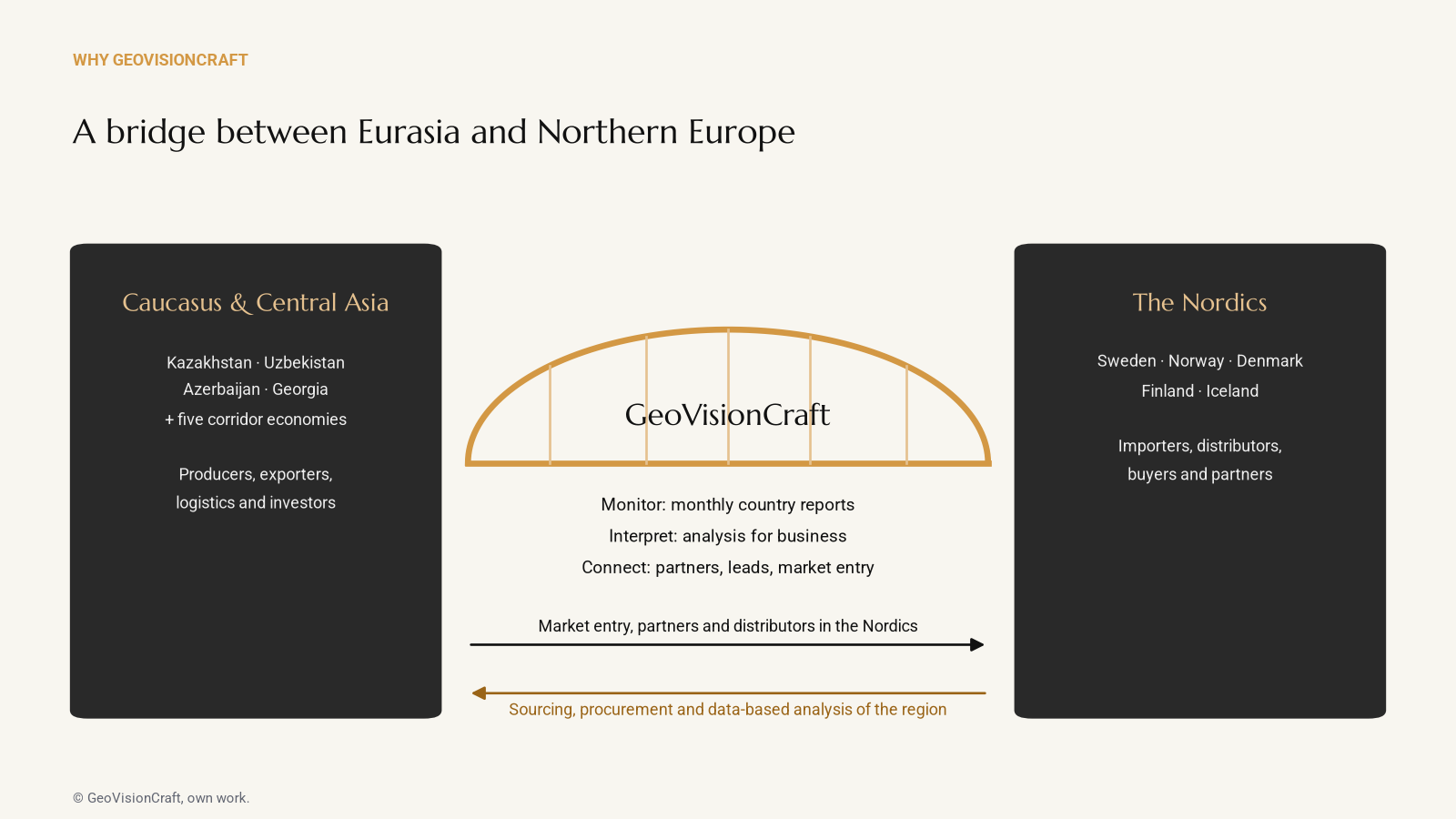
Monitor
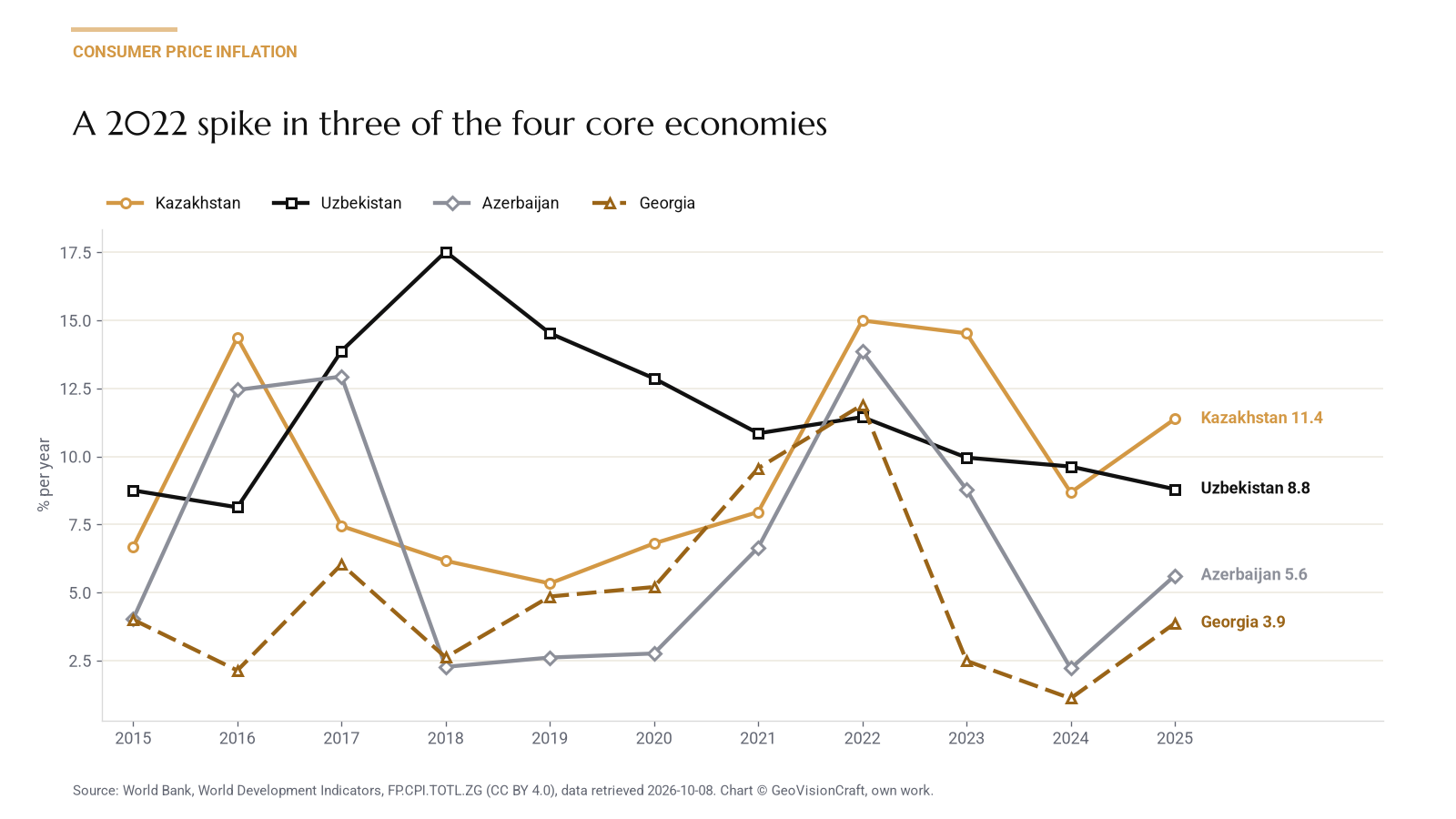
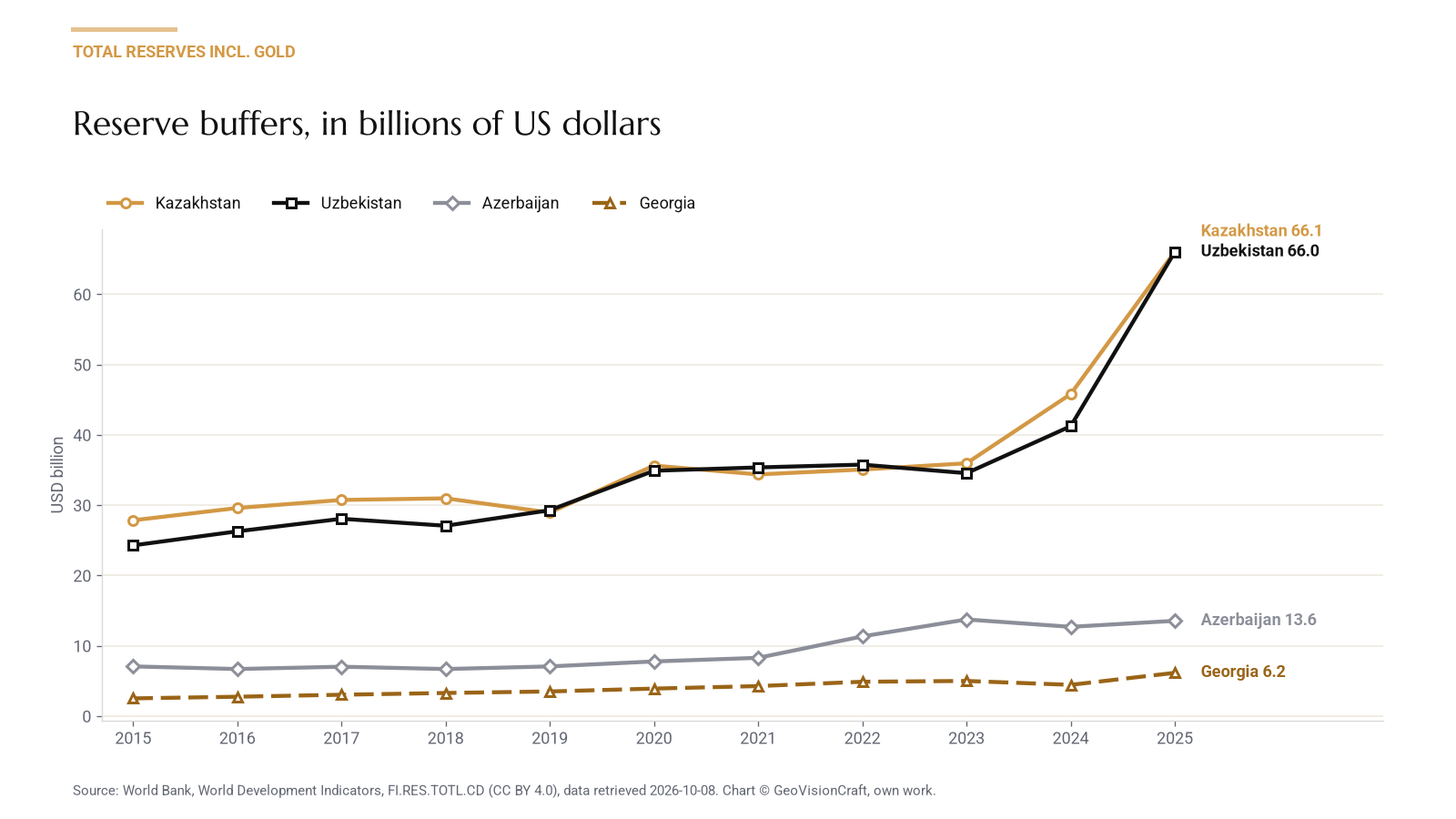
Monthly country reports for Kazakhstan, Uzbekistan, Azerbaijan and Georgia: inflation, interest rates, money and credit, the currency and reserves, refreshed from official data.
Economies we track →Interpret
We turn the numbers into practical implications for pricing, sourcing, market entry and risk. Where it helps, we add our gold lens, which measures currencies and prices in gold as well as in dollars.
Connect
Partner and contact matching, lead generation, market research in Northern Europe and importer/distributor search, plus the full BusinessCraft toolbox.
Get in touch →We use official sources first: national central banks and statistics offices, then international institutions such as the World Bank. Every figure shows its source and data period, and all maps and charts on this site are our own work. Our analysis is not investment advice.
Who is behind GeoVisionCraft
GeoVisionCraft is a BusinessCraft Nordic company. It is operated by BusinessCraft Nordic AB, a Swedish limited company.
- Company
- BusinessCraft Nordic AB
- Corporate ID no.
- 559102-8732
- VAT no.
- SE559102873201
- Registered address
- c/o Giorgi Skhirtladze, Berghemsgatan 8 Lgh 1001, 431 37 Mölndal, Sweden
- Contact
- giorgi@geovisioncraft.com · Contact form
- Parent company website
- businesscraft.se
Sources
- World Bank (2023). Middle Trade and Transport Corridor: Policies and Investments to Triple Freight Volumes and Halve Travel Time by 2030. Washington, DC: World Bank. Figures 4–5 and the facts in the route table are redrawn from this report.
- World Bank. World Development Indicators, CC BY 4.0, data retrieved 2026-10-08 (Figures 6–8).
- Ministry of Foreign Affairs of the People’s Republic of China; State Council Information Office white paper on the Belt and Road (October 2023).
- European Commission, Global Gateway (1 December 2021); Council of the EU, joint press release after the first EU–Central Asia summit (4 April 2025).
- Office of the President of Azerbaijan, opening of the Baku–Tbilisi–Kars railway (30 October 2017); Government of Uzbekistan, China–Kyrgyzstan–Uzbekistan railway.
- Natural Earth, 1:50m and 1:110m Admin 0 countries, public domain (map borders, Figures 2–3).
Planning to sell in the Nordics?
Tell us about your company and what you need. We reply with a short proposal.
Request a proposal